
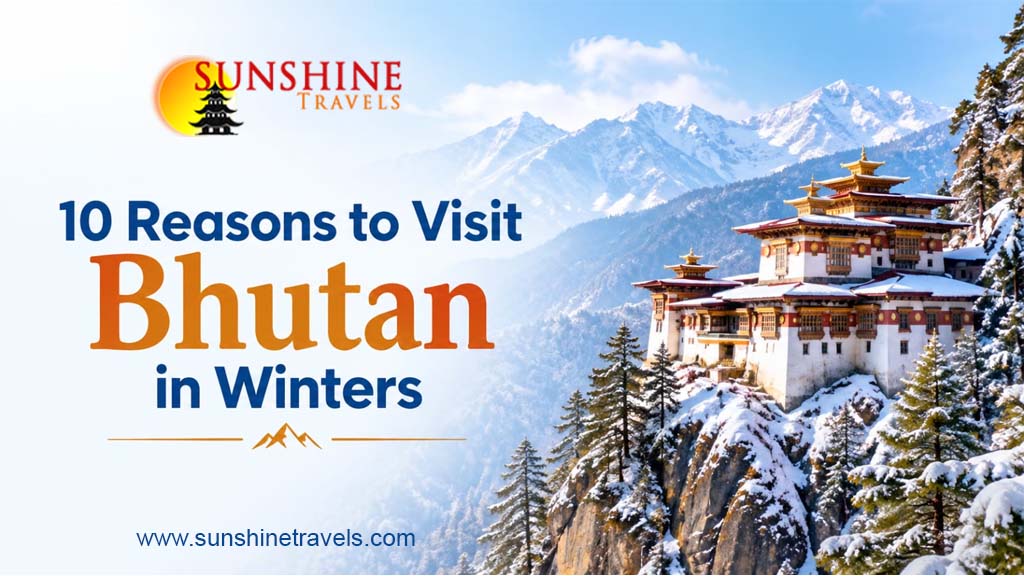
10 Reasons to Visit Bhutan in Winters
Everyone talks about October. Everyone books April.
And while those months are genuinely wonderful, they have also become Bhutan’s busiest, most expensive, most crowded windows. Hotels fill up weeks in advance. Popular trails get busy by mid-morning. Festival-week prices climb sharply.
Bhutan in winters – December, January, February – is a completely different story.
Same monasteries. Same mountains. Same prayer flags on the same winding roads. But quieter, cheaper, and with a kind of clarity that peak season simply cannot offer. Winter Bhutan is not a consolation prize. For the right traveler, it is the best trip.
Here are ten reasons why.
1. The Crowds Simply Disappear
Walk into Punakha Dzong in October and you share it with dozens of tour groups. Walk in on a January morning and you might share it with three monks and a caretaker.
That is not an exaggeration.
Winter strips Bhutan’s most famous sites back to what they actually are – places of genuine culture and history – rather than a backdrop for a hundred people taking the same photograph. You move at your own pace. You stop where you want. You stand in a monastery courtyard in complete silence and actually feel where you are.
For anyone who has ever visited a beautiful place and felt cheated by the crowd around them, Bhutan in winter is the answer.
2. Hotel Rates Drop Noticeably
The same room that costs ₹5,000 a night in October often costs ₹2,500 to ₹3,000 in January.
Bhutan’s mid-range hotels are good – clean, well-run, and genuinely warm in the way that Bhutanese hospitality tends to be. In winter, they have availability, they are motivated to offer better rates, and you are not competing with thirty other groups for the same booking window.
If budget is a real consideration – and for most travelers it is – winter is when a Bhutan tour package gives you the most value for your money. Same country, same experience, noticeably lower cost.
3. Punakha in Winter Is Extraordinary
Most people do not realise that Punakha, sitting at a lower altitude than Thimphu and Paro, stays genuinely warm even in the heart of winter. Daytime temperatures regularly reach 16°C to 18°C. It feels like early spring while the rest of the country wears a frost.
And in February, something remarkable happens. The Punakha Tshechu and Drubchen – one of Bhutan’s most important festivals – takes place right here in the valley. Masked dances at the dzong. Monks in ceremonial robes. Locals in their finest kira and gho gather from surrounding villages.
It is one of the most visually striking festivals in all of Bhutan, and in winter it draws a fraction of the crowd that Paro Tshechu pulls in April. You see the same tradition, the same ceremony, the same beauty – with room to actually stand and watch.
4. The Mountain Views Are at Their Clearest
Ask any photographer who has visited Bhutan in multiple seasons. They will tell you the same thing: winter air is the clearest.
No monsoon haze. No pre-monsoon dust. Just cold, dry, sharp air that turns the Himalayas into something you can see in precise detail from Dochula Pass, from Thimphu’s ridgelines, from the Tiger’s Nest trail.
On a clear January morning at Dochula Pass, peaks above 7,000 metres – Gangkhar Puensum, Masagang, Tsendagang – appear so close and so defined that first-time visitors genuinely cannot believe what they are looking at. This is the view that makes people immediately start planning a second trip.
5. Tiger's Nest Without the Queue
The Tiger’s Nest trail in peak season starts filling up by 8:00 AM. By mid-morning it is a steady stream of hikers going up and coming down on the same narrow path.
In winter, you can start the hike at 8:30 AM and have long stretches of the trail completely to yourself. The air is cool and dry – actually ideal hiking conditions. The valley below is sharper and quieter. And at the top, the monastery feels more like what it actually is: a place of serious spiritual practice, not a popular attraction.
The hike itself is no harder in winter. Dress in layers, start after the sun is fully up, and carry something warm for the top. The rest takes care of itself.
6. Paro's Rhino Fortress and Valley Feel Different in the Cold
Paro in winter has a particular quality that is difficult to describe and easy to feel.
The valley is cool and still. Frost sits on the rice fields in the early morning. The light in the afternoon turns gold faster than in summer and stays warm longer on the dzong walls.
Rinpung Dzong is one of those buildings that genuinely looks better in certain conditions. Winter is one of them. The stone, the woodwork, the flags above the entrance – all of it sits differently under a sharp winter sky than it does in the hazy warmth of May.
Paro town is also easier to navigate and shop in when it is not managing peak-season footfall. The shopkeepers have time to talk. Prices are more flexible. The whole experience has a different texture.
7. Thimphu Is Quieter and More Local
Thimphu in peak season buzzes with tourists. Restaurants fill up. The Weekend Market gets crowded. Norzin Lam – the main street – carries the particular energy of a city managing a large number of visitors at once.
In winter, Thimphu feels more like a capital city that belongs to its residents. Locals eat at the restaurants rather than waiting for tables to turn over. The market has more interesting products and fewer cameras pointed at it. The temples are visited by people who come to pray, not to photograph.
The Buddha Dordenma in the early morning winter light – cold, clear, golden – is one of those images that stays with you longer than most things you photograph on a trip.
8. The Druk Wangyal Tshechu at Dochula
In mid-December, Dochula Pass hosts one of Bhutan’s most unique festivals – the Druk Wangyal Tshechu. Held at the Druk Wangyal Lhakhang beside the 108 chortens, with the Himalayan range as a backdrop on a clear day.
This festival was established in honour of the fourth king and combines traditional masked dances with a setting that no other Bhutan festival can match. The altitude, the open sky, the chortens, the peaks – all of it together is something genuinely rare.
It is also one of the least crowded major festivals in Bhutan’s calendar. Most peak-season travelers miss it entirely because they have already come and gone.
9. The Black-Necked Cranes Are Still in Phobjikha
Between October and February, Black-Necked Cranes migrate from the Tibetan Plateau and winter in Phobjikha Valley. Hundreds of them. Landing in the fields at dusk, calling across the valley in the early morning, utterly unbothered by the humans who drive hours to watch them.
December, January, and early February are actually the peak crane months – more reliable than October, when some birds are still arriving. The Black-Necked Crane Festival in mid-November catches most visitors; the best viewing comes in the quieter winter weeks that follow.
Phobjikha in winter is cold at night. During the day it is peaceful in a way that takes time to settle into. Wide open valley, a winding stream, Gangtey Monastery on the hill. Not many travelers see it in January. The ones who do rarely stop talking about it.
10. You Actually Get to Know Your Destination
This is the reason that is hardest to put in a list but most important to say.
Bhutan in peak season is a wonderful trip. But it is also a managed trip – you move with the flow of other travelers, book what is available, and experience a country that is partly in performance mode because it is hosting so many people at once.
In winter, Bhutan relaxes. The locals have more time. Your driver – booked through a reliable tour operator in Bhutan who knows the off-season roads – knows exactly which viewpoints are worth stopping at when there is no one else there. Your guide takes you to the monastery that is not on the standard route because in January there is time for it.
A good car rental in Bhutan in winter means flexible stops, unhurried drives, and the kind of road trip that feels like it was designed for you – because, in a real sense, it was.
What to Pack for Bhutan in Winter
- Thermal base layers – mornings and evenings are cold across the country
- A proper warm jacket – not a light travel layer; something that actually works at 3,000 metres
- Waterproof shoes – frost and occasional light snow in higher areas
- Sunscreen – winter sun at altitude is still strong
- Small denomination Indian Rupees – ₹500 and ₹100 notes; ₹2,000 are not accepted
- A power bank – cold temperatures drain phone batteries faster than expected
Winter Bhutan at a Glance
Destination | Winter Temperature | Worth Visiting in Winter? |
Thimphu | 2°C – 12°C | Yes – quieter, clearer skies |
Paro | 1°C – 10°C | Yes – Tiger’s Nest without crowds |
Punakha | 8°C – 18°C | Absolutely – warmest valley, Tshechu in Feb |
Dochula Pass | -2°C – 6°C | Yes – best Himalayan views of the year |
Phobjikha | -4°C – 8°C | Yes – peak crane season |
Frequently Asked Questions
Is Bhutan worth visiting in winter?
Which is the warmest place in Bhutan during winter?
What festivals happen in Bhutan in winter?
Is the Tiger's Nest hike safe in winter?
Are Bhutan tour packages cheaper in winter?
Do I still need a travel agency in Bhutan for a winter trip?
What is the SDF fee for winter travel in Bhutan?
Plan Your Winter Bhutan Trip With Sunshine Travels
Winter is when Bhutan stops performing and starts just being itself.
The dzongs are quieter. The trails are yours. The mountain views are sharper than at any other time of year. And the trip costs less – which means you can stay longer, go further, or simply enjoy the same experience without watching the budget as closely.
Sunshine Travels, an experienced travel agency in Bhutan is based at the Indo-Bhutan border in Jaigaon. We handle permits, SDF, licensed guides, accommodation, and car rental in Bhutan – everything sorted before you step through the gate. Winter bookings move faster than people expect. The good hotels and vehicles go first, even in the quiet season.
 +91 85388 33174 | +91 81163 74561
  +975 77767734 (Bhutan)
 sunshinetourandtravelsindia@gmail.com

 www.sunshinetourandtravels.com
 Indo-Bhutan Border, N.S. Road, Opposite Domino’s Pizza, Jaigaon – 736182
Tell us your dates. We will take care of everything else.