
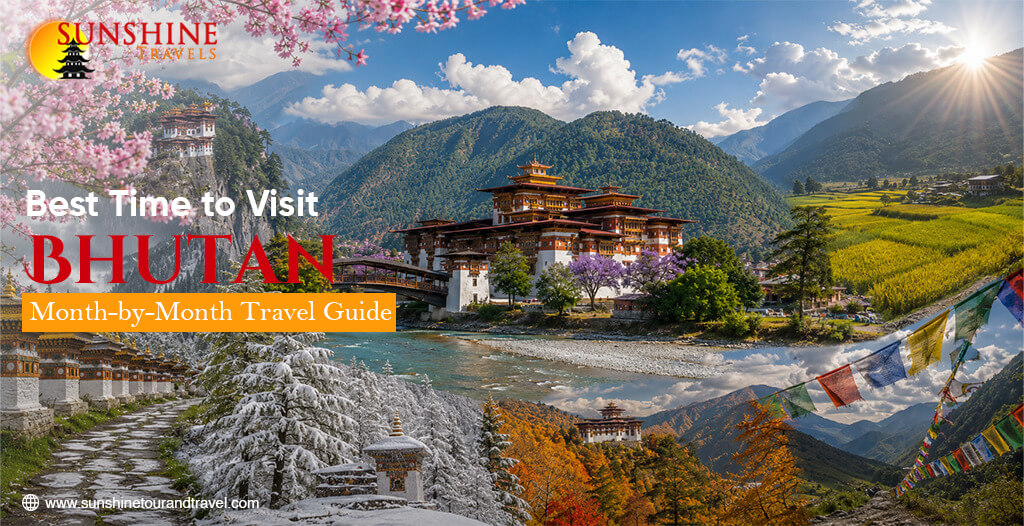
Best Time to Visit Bhutan: Month-by-Month Travel Guide
The best time to visit Bhutan is October-November and March-April, clear skies, comfortable temperatures, and the country’s biggest festivals all land in these windows. But every season offers something worth seeing.
This Bhutan travel guide breaks down every month so you can find the right window for the trip you actually want. Spring rhododendrons. Autumn mountain views. Winter silence. Monsoon green. Let’s find your season.
This guide is put together by Sunshine Travels, a Jaigaon-based travel agency operating directly at the Bhutan border. We plan Bhutan trips year-round – which means we know every season from the road, not just from a calendar.
Peak Season vs Off-Season: The Real Difference
Same country. Two completely different trips.
Peak season means clear skies, big festivals, and company on the trail. Off-season means empty dzongs, quiet valleys, and prices that finally make sense.
Season | Months | What You Get | What It Costs |
Peak | Mar–May, Sep–Nov | Clear skies, big festivals | Higher prices, book early |
Shoulder | Feb, Jun, Dec | Mild weather, thinner crowds | Better value |
Low | Jul–Aug, Jan | Rain or deep cold | Cheapest, quietest |
Peak season Bhutan feels alive. Low season Bhutan feels like yours alone. Neither is wrong.
Bhutan Weather by Month
Bhutan’s weather changes dramatically from season to season – and so does the experience. Knowing what each month brings helps you match your trip to the moments that matter most to you.
Spring in Bhutan (March–May): Rhododendrons & Paro Tshechu
March brings warm days and cool nights. Rhododendrons start climbing the hillsides, pinks, reds, and whites spreading across the valleys. Punakha’s Tshechu and Drubchen usually light up this month too. Temperatures in Thimphu sit around 10°C–18°C.
April is the showstopper month. Clear skies. Comfortable air. Dochula Pass and Phobjikha Valley turn into a rhododendron festival of their own. And Paro Tshechu – one of Bhutan’s grandest festivals – usually unfolds at Rinpung Dzong. Thimphu averages 12°C–20°C in April.
May is warmer and a little hazier, still trek-friendly before the rains roll in. Expect temperatures around 15°C–23°C in the valleys.
If you love flowers, mountains, and festival crowds, spring is your season.
Bhutan in Monsoon Season (June–August): Rain, Green Valleys & Low Prices
Rain scares people off. It shouldn’t scare you.
June brings rising humidity. The hills turn a rich, saturated green. Temperatures stay pleasant at 17°C–25°C but the air is thick.
July and August bring short, heavy downpours, not all-day washouts. Mornings often stay clear. Waterfalls swell. Orchids bloom. Crowds vanish. Average temperatures hover around 18°C–26°C in lower valleys like Punakha.
Entering via Jaigaon? The Phuentsholing border crossing is open year-round, but monsoon landslides occasionally cause delays on the onward road to Thimphu between July and August. Build at least one buffer day into your itinerary if you are travelling during this period.
Autumn in Bhutan (September–November): Best Weather & Festival Season
If Bhutan has a headline season, this is it.
September marks the end of monsoon. Skies open up. Thimphu Tshechu usually falls here – three unforgettable days at Tashichho Dzong, and one of the easiest festivals for first-timers to attend. Temperatures return to a comfortable 12°C–22°C.
October delivers the sharpest mountain views of the entire year. Perfect for flights into Paro, perfect for trekking. Wangdue Phodrang and Jakar Tshechus add more color to the month. Expect 10°C–20°C in most valleys.
November stays cool, dry, and clear. The rare Black-Necked Cranes arrive in Phobjikha Valley, and Bumthang’s Jambay Lhakhang Drup brings fire dances and masked rituals. Temperatures drop to 5°C–15°C toward month’s end.
Book early. This season fills up fast.
Winter in Bhutan (December–February): Fewer Crowds, Lower Costs
Cold mornings. Warm sun. Empty dzongs. Winter in Bhutan is a different kind of beautiful.
December is crisp and dry, with sunny afternoons averaging 5°C–14°C. Dochula Pass hosts the Druk Wangyel Tshechu in mid-December.
January is the coldest stretch, with snow dusting Thimphu and Bumthang. Temperatures can dip to -2°C at night in higher areas. Punakha, lower and gentler, stays comfortable even now – daytime temperatures around 10°C–18°C.
February warms back up, right as Punakha’s Tshechu and Drubchen return to the valley. A great time to visit if you want festivals without peak-season crowds.
Winter trades a little warmth for a lot of peace – and a much lighter bill.
Bhutan's Festival Calendar, at a Glance
Festival dates follow the lunar calendar, so they shift every year. Here’s roughly when to expect them:
- Punakha Tshechu & Drubchen: Late February to early March
- Paro Tshechu: Late March to April
- Haa Summer Festival: July
- Thimphu Tshechu: late September to early October
- Wangdue Phodrang & Jakar Tshechus: September/October
- Jambay Lhakhang Drup: late October/November
- Black-Necked Crane Festival: mid-November
- Druk Wangyel Tshechu: 13 December
These are Bhutan’s busiest travel windows. Rooms and flights go first. Guides go second. Don’t wait.
Which Season Fits You?
Every traveller comes to Bhutan with a different priority – and every season serves a different kind of trip. Use this quick guide to find yours.
- First trip to Bhutan? October or April. No downsides.
- Chasing a festival? Plan around Paro Tshechu or Thimphu Tshechu.
- Trekking? Autumn or spring. Skip the monsoon and deep winter snow.
- Watching your budget? June or January.
- Love flowers and photography? Late March into April.
Frequently Asked Questions (FAQs)
Q1. What is the single best month to visit Bhutan?
Q2. Is Bhutan worth visiting in the monsoon?
Q3. Is winter too cold to visit Bhutan?
Q4. When is Bhutan the most crowded?
Q5. When should I book if I want to see a Tshechu?
Q6. Is there a bad time to visit Bhutan?
Q7. Do I need a guide no matter when I visit?
Q8. Does the Bhutan SDF (Sustainable Development Fee) change by season?
Ready to Pick Your Season?
Every month in Bhutan tells a different story. Yours is waiting to be written.
Sunshine Travels plans it all – the right season, the right festivals, the right roads. We’re based right on the Bhutan border in Jaigaon, and we know these valleys well.
Talk to us today. Let’s build your Bhutan trip before the best dates disappear.