
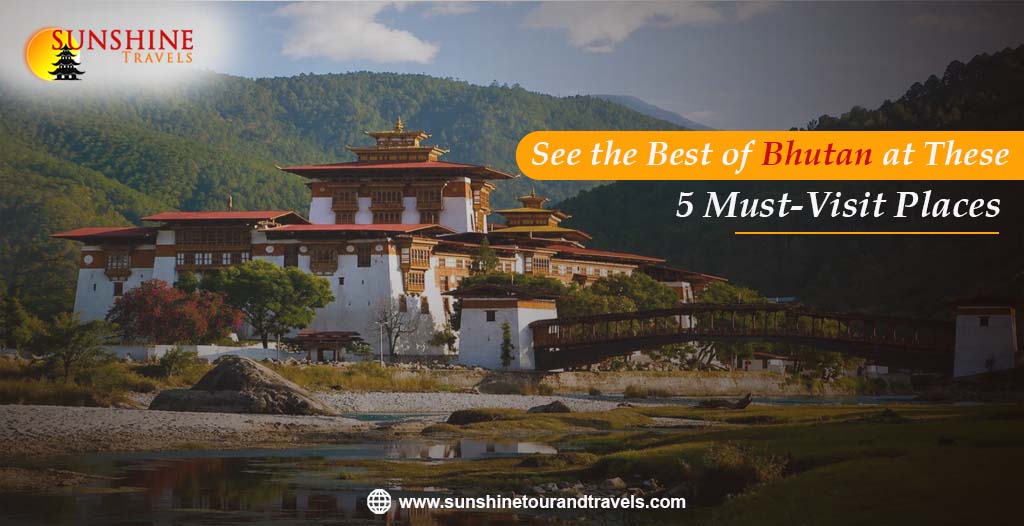
See the Best of Bhutan at These 5 Must-Visit Places
Some countries hand you a list of tourist attractions.
Bhutan hands you something else entirely.
It hands you a monastery on a cliff that took two hours to climb. A fortress sitting between two rivers at golden hour. A valley where cranes land every winter like they own the place. A capital city without a single traffic light.
The places to visit in Bhutan are not just beautiful. They are the kind of places that change the way you think about travel – quietly, without making a big deal of it.
If you are visiting Bhutan for the first time, or even the second, here are the five places that belong on every itinerary. Not because a travel app said so. Because anyone who has stood there will tell you the same thing.
1. Paro - The Valley That Has Everything
Paro is where most travelers land. And it is where most travelers fall in love with Bhutan.
The valley is wide and flat, which feels unusual in a country this mountainous. A river runs through the middle. Farmhouses with painted wooden windows sit between rice fields. The mountains frame all of it like they were placed there deliberately.
But the real reason Paro tops every list of places to visit in Bhutan is not the valley. It is what sits above it.
Tiger's Nest - Taktsang Monastery
You have seen the photograph. Everyone has. A monastery clinging to a 900-metre cliff face, prayer flags trailing in the wind, clouds drifting past.
The photograph does not prepare you for actually being there.
The hike takes about two hours going up. It is steep in places, rocky in others, and worth every single step. There is a cafeteria halfway up where you can sit with a hot drink and look out over the valley below — and you will sit there longer than you planned because the view makes you forget you were going somewhere.
At the top, Taktsang Monastery is quieter than you expect. Built in 1692 around the cave where Guru Rinpoche meditated in the 8th century. The monks move through it like it is just another Tuesday. For them, it is.
Also in Paro:
- Rinpung Dzong – a 15th-century fortress with woodwork so detailed it takes a few minutes to properly look at it
- Kyichu Lhakhang – one of Bhutan’s oldest temples, built in the 7th century, small and deeply peaceful
- National Museum of Bhutan – six floors of history that explains Bhutan better than most guides can
- Drukgyel Dzong – a ruined fortress at the end of the valley with clean Himalayan views on a clear day
Tip: Start the Tiger’s Nest hike by 7:00 AM. The trail gets busy by mid-morning and the afternoon clouds can roll in fast.
2. Thimphu - The Capital That Refused to Grow Up
Thimphu is the only capital city in the world with no traffic lights.
They tried installing one once. Drivers and pedestrians ignored it so completely that the government eventually gave up and put a traffic cop back at the main junction. That cop now directs traffic from a painted booth in the middle of the road and somehow makes it work better than any signal ever did.
This is Thimphu. Modern enough to have coffee shops and Wi-Fi. Traditional enough to require that all buildings – every single one – follow Bhutanese architectural rules. No glass towers. No concrete boxes. Just painted wooden facades and sloped rooftops, even at the bank.
What to See in Thimphu
Buddha Dordenma is where you start. A 51-metre golden Buddha sitting on a hillside above the city. Go in the morning. The valley spread below it, the mountains behind it, the silence around it – this is the photograph that starts every Bhutan album.
Tashichho Dzong is the seat of Bhutan’s government and one of its most important monasteries. Visit late afternoon when the light turns orange and monks begin their evening movements between the courtyards. Stay longer than you think you need to.
National Memorial Chorten is not a tourist attraction. It is a living part of the city – elderly locals circle it every morning with prayer beads, exactly as they have done every morning for decades. Watch before you photograph.
Changangkha Lhakhang sits on a ridge above Thimphu with a view over the valley. One of the oldest temples in the city. Quieter than the main sights and more atmospheric because of it.
Weekend Market – if you are there on Saturday or Sunday, go. Dried chillis. Hand-woven fabric. Local vegetables. Incense. The kind of market where you buy things you did not plan to buy and feel good about all of them.
Tip: Thimphu deserves a full day. Do not try to combine it with Punakha on the same day – you will shortchange both.
3. Punakha - The Place That Stops People Mid-Sentence
Ask anyone who has been to Bhutan which place surprised them most. More often than not, they say Punakha.
It is lower than Thimphu. Warmer. Greener. The air feels different here – softer, somehow. Rice fields line the road into the valley. Banana trees grow alongside them. After the pine forests and mountain passes, Punakha feels like a reward.
Punakha Dzong
Built in 1637 and still standing with absolute confidence.
Punakha Dzong sits at the meeting point of the Pho Chhu and Mo Chhu rivers – the Father River and the Mother River. In spring, jacaranda trees bloom purple along the entrance walkway. In winter, the water runs cold and clear and the dzong reflects in it.
Walk through the courtyards slowly. Look up at the painted ceilings. Find the room where Bhutan’s first king was crowned in 1907 and take a moment to understand how long this kingdom has been standing.
This is not just a dzong. It is widely considered the most beautiful building in Bhutan. After you visit, you will not argue with that.
Also in Punakha:
- Suspension Bridge – a short walk from the dzong, prayer flags overhead, the Mo Chhu below. Good for photos, better for the feeling it gives you
- Chimi Lhakhang – a 20-minute walk through rice paddies to the Temple of the Divine Madman. Quirky, sacred, unlike anything else in Bhutan
Tip: Stay overnight in Punakha. The valley is at its best in the early morning before the tour groups arrive.
4. Dochula Pass - The View That Earns Its Reputation
Dochula Pass sits at 3,100 metres between Thimphu and Punakha. Most people drive through it on the way to the dzong. The ones who stop for an hour are the ones who talk about it for years.
108 white chortens arranged in a curved row on the hilltop. Built to honour Bhutanese soldiers who died in a military operation in 2003. On a clear morning – and October mornings are often very clear – the entire eastern Himalayan range spreads across the horizon behind them.
Gangkhar Puensum. Masagang. Tsendagang. Peaks above 7,000 metres, close enough that you feel like you could touch them if the air were not already doing something strange to your breathing.
This is one of those views where people go quiet. Not because they have nothing to say. Because nothing they could say would be adequate.
Also at Dochula:
- Druk Wangyal Lhakhang – a temple at the pass with beautiful paintings inside, often overlooked by travelers rushing to Punakha
- Dochula Resort – if the clouds are in, have tea here and wait. Sometimes the peaks appear for just fifteen minutes. Worth every minute of waiting.
Tip: The pass is best in autumn and early spring. Monsoon months bring clouds that can block the peaks entirely. Go early in the day regardless of season.
5. Phobjikha Valley - The One Most Travelers Miss
Most first-time itineraries do not include Phobjikha. That is a mistake.
This glacial valley in central Bhutan is one of the few broad, flat valleys in the entire country. No dzong towers over it. No busy market runs through it. Just wide open farmland, a winding stream, a small monastery on a hill, and the kind of quiet that makes city people uncomfortable for the first ten minutes and completely addicted for the rest.
The Black-Necked Cranes
Every year, between October and February, Black-Necked Cranes fly in from the Tibetan Plateau and spend the winter in Phobjikha. Hundreds of them. Landing in the fields at dusk, calling to each other across the valley, going about their winter in complete indifference to the humans watching them.
There is even a festival – the Black-Necked Crane Festival in mid-November – where locals celebrate the cranes’ arrival with traditional dances and songs. It is one of Bhutan’s lesser-known festivals and genuinely one of its most moving.
Also in Phobjikha:
- Gangtey Monastery (Gangtey Goenpa) – one of Bhutan’s most important Nyingma monasteries, sitting on a hill above the valley with views that stretch across the entire basin
- Valley walks – there are easy walking trails around the valley floor that take you past farmhouses, streams, and crane feeding grounds
- Phobjikha Village – small, unhurried, and exactly the kind of place that makes you reconsider your return flight
Tip: Visit between late October and early February to see the cranes. If you are adding Phobjikha to your itinerary, plan for at least one extra night – the valley deserves a morning.
How to See All 5 Places: Recommended Itinerary
Day | Route | Highlights |
Day 1 | Jaigaon → Phuentsholing → Thimphu | Border crossing, evening settle-in |
Day 2 | Thimphu | Buddha Dordenma, Tashichho Dzong, market |
Day 3 | Thimphu → Dochula Pass → Punakha | 108 chortens, Punakha Dzong, Chimi Lhakhang |
Day 4 | Punakha → Paro | Rinpung Dzong, National Museum, Kyichu Lhakhang |
Day 5 | Paro | Tiger’s Nest hike — full morning |
Day 6 | Paro → Phobjikha Valley | Gangtey Monastery, valley walk, cranes (Oct–Feb) |
Day 7 | Phobjikha → Phuentsholing → Jaigaon | Return journey |
What to Know Before You Go
Permits are mandatory. Every Indian traveler needs a Bhutan Entry Permit plus area permits for each destination. A licensed operator arranges all of this – you do not need to chase paperwork yourself.
SDF applies every night. The Sustainable Development Fee is ₹1,200 per person per night for Indian nationals. For a 6-night trip, that is ₹7,200 per person. It is included in most licensed tour packages.
Car rental in Bhutan is part of every package. All five places on this list are connected by road. A private vehicle – sedan, Innova, or SUV depending on group size – is the standard and most comfortable way to travel between them. Your operator arranges this as part of the package.
Dress codes matter at dzongs and monasteries. Cover your shoulders and knees. Carry a light scarf or layer – it takes no space and gets you through every entrance without being turned away.
Indian Rupees work everywhere. But carry ₹500 and ₹100 notes. ₹2,000 notes are routinely refused across Bhutan.
Frequently Asked Questions
What are the top places to visit in Bhutan for first-timers?
How many days do I need to see all 5 places?
Is Phobjikha Valley actually worth the extra day?
When is the best time to visit these places?
Do I really need a travel agency for Bhutan?
See All 5 with Sunshine Tour and Travels
Five places. Seven days. One trip that earns every rupee you spend on it.
Sunshine Travels is based at the Indo-Bhutan border in Jaigaon – right where your Bhutan journey begins. We handle permits, SDF, licensed guides, accommodation, and vehicles across every destination on this list.
We know these roads. We know which monastery is best at dawn and which dzong is worth staying an extra hour at. We know when the cranes land in Phobjikha and which month Dochula gives you the clearest peaks.
That is what a border-based operator gives you that no city agency can.
 +91 85388 33174 | +91 81163 74561
  +975 77767734 (Bhutan)
 sunshinetourandtravelsindia@gmail.com

 www.sunshinetourandtravels.com
 Indo-Bhutan Border, N.S. Road, Opposite Domino’s Pizza, Jaigaon – 736182
Tell us your dates. We will take care of everything else.