
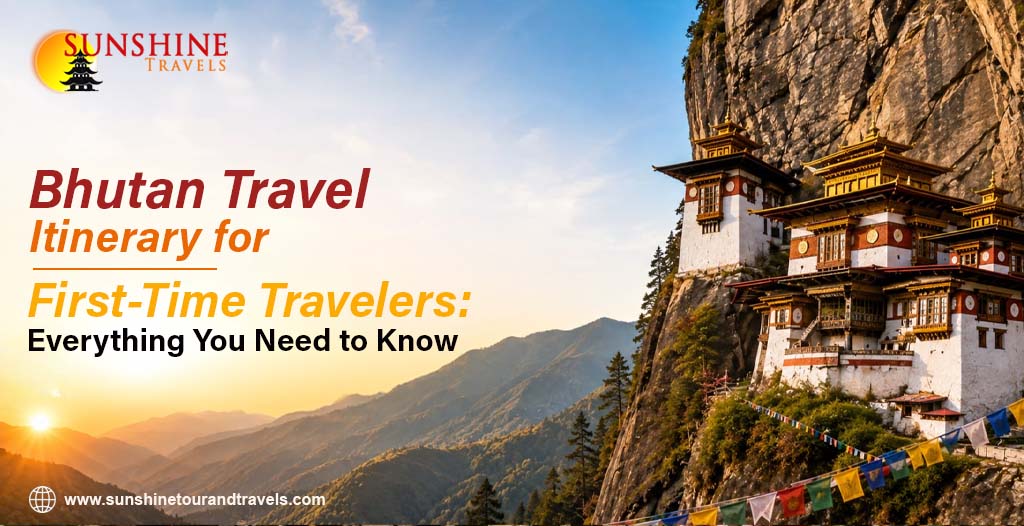
Bhutan Travel Itinerary for First-Time Travelers: Everything You Need to Know
Nobody talks about the moment they cross the Bhutan Gate for the first time.
They talk about Tiger’s Nest. They talk about Punakha Dzong. They post the Dochula Pass photos.
But that first moment walking through the gate at Phuentsholing, leaving the noise of Jaigaon behind – that’s the one that quietly changes the trip. The roads get cleaner. The air smells different. Even the silence sounds different.
If you’re planning your first Bhutan trip, this itinerary is for you. Not a copy-paste template. A real plan – the kind we build for actual travelers, every week, right here from the border.
First Question Everyone Asks: How Many Days?
Five nights, six days.
Not four. Not three. Five.
Here’s why: Bhutan has three places that every first-time visitor needs to see – Thimphu, Punakha, and Paro. Each one deserves a full day, not a rushed half-morning.
Add the Tiger’s Nest hike on Day 5 and the drive days on either end, and five nights is exactly what makes this trip feel complete rather than exhausting.
Got an extra day or two? Add Bumthang. It’s quieter, older, and the kind of place that makes you reconsider your entire travel style. But for a first trip – five nights, start to finish.
Day 1: Jaigaon to Thimphu
Most people underestimate this day. Don’t.
Cross into Phuentsholing early. Your permits get processed at the immigration office – usually takes about an hour, sometimes two. Your operator handles the paperwork; you handle the butter tea.
Walk around Phuentsholing while you wait. It’s a border town, so it has that particular energy – Bhutanese on one side, Indian on the other, everyone moving back and forth like it’s the most normal thing in the world. Because here, it is.
Once permits are clear, the drive to Thimphu begins. About five hours through pine forests and mountain roads that get progressively more dramatic the higher you climb. Keep your window down. Take the photos you’ll actually keep.
Arrive in the evening. Eat something simple. Sleep well. Tomorrow is a full day.
Drive: Jaigaon → Thimphu | ~176 km | ~5 hours
Day 2: Thimphu
Thimphu is the only capital city in the world without a single traffic light. They tried installing one once. People hated it. They went back to a traffic cop at the main junction.
That tells you something about Thimphu.
Start at Buddha Dordenma. A 51-metre golden Buddha sitting above the valley. Go in the morning before the tour groups arrive. Stand there for a few minutes and just look at the city below. It sets the right tone for the day.
Tashichho Dzong is best in the late afternoon when the light turns golden and monks in burgundy robes walk between the courtyards. Don’t rush this one.
National Memorial Chorten is where locals come every morning – elderly men and women circling the structure with prayer beads, murmuring quietly. It’s not a tourist attraction. It’s a living part of this city. Watch for a while before you photograph.
If it’s a weekend, the Thimphu Market is worth an hour. Dried chillis. Hand-woven fabric. Things you’ll buy and be glad you did.
In the evening, walk down Norzin Lam – the main street – and find a local restaurant. Order ema datshi. It’s Bhutan’s national dish: chilli and cheese cooked together into something that’s spicier than it looks and better than it sounds.
Day 3: Thimphu → Dochula Pass → Punakha
Wake up a little earlier today. The drive from Thimphu to Punakha climbs over Dochula Pass at 3,100 metres, and on a clear morning, you want to be there before the clouds roll in.
108 white chortens arranged in a curve. Himalayan peaks stretching across the horizon – Gangkhar Puensum, Masagang, Tsendagang – peaks most people never see this close. It’s the kind of view that makes you put your phone down.
Then the road drops steeply into Punakha valley. Warmer here. Greener. Rice fields and banana trees instead of pine.
Punakha Dzong was built in 1637 and it still looks like it was built to last another four hundred years. It sits at the point where two rivers – the Pho Chhu and Mo Chhu – meet. Walk through the courtyards slowly. Look up at the painted ceilings. Sit by the river for ten minutes before you leave.
After the dzong, walk across the suspension bridge nearby – prayer flags above you, the Mo Chhu rushing below – and then follow the rice paddy path to Chimi Lhakhang, the fertility temple. It’s a 20-minute walk through fields that smells like real countryside and ends at a temple that has been making people laugh and feel blessed for centuries.
Stay overnight in Punakha. The valley is quieter here than Thimphu. Dinner by a window with a river view – this is what people mean when they say Bhutan stays with you.
Drive: Thimphu → Punakha | ~72 km | ~2.5 hours with stops
Day 4: Punakha → Paro
The drive from Punakha back over the mountains and down into Paro valley is one of those roads that makes you glad you chose road travel over flying.
Paro is wider, flatter, and calmer than Thimphu. The valley stretches out properly. You can see the mountains from your hotel window. The town itself takes about twenty minutes to walk end to end – and that’s perfectly fine.
Rinpung Dzong sits above the town on a rocky slope. 15th century. Still standing without apology. The woodwork inside is some of the finest in Bhutan – carved, painted, and maintained with the kind of care that makes you realize how seriously this country takes its own history.
The National Museum of Bhutan is in the round watchtower above the dzong – six floors of thangkas, weapons, natural history, and objects that explain Bhutan better than any guide can. Allow an hour and a half.
Kyichu Lhakhang is one of Bhutan’s oldest temples, built in the 7th century. Small, quiet, and deeply peaceful. The kind of place you visit for fifteen minutes and think about for fifteen years.
Rest in the afternoon. Eat an early dinner. Go to bed by nine. Tomorrow starts before sunrise.
Day 5: Tiger's Nest
There is nothing else to put on today’s itinerary. Tiger’s Nest is the day.
Taktsang Monastery hangs on a 900-metre cliff face above Paro valley like something someone dared the universe to build. First constructed in 1692 around the cave where Guru Rinpoche meditated in the 8th century. It looks impossible from below. It looks earned from up close.
The hike:
- Start by 7:00 AM – before the crowds, before the heat
- 2 to 2.5 hours going up for most people; take your time
- There’s a cafeteria halfway with hot drinks and the kind of view that makes you forget your legs hurt
- The final section involves a steep staircase down into a gorge and back up – this is where it gets real
- Once inside: no cameras. Phones only. And speak quietly.
- Coming down takes about 1.5 hours
Practical things:
- Horses are available at the trailhead for the lower section – worth it if anyone in your group needs them, no shame in it
- Entry fee is ₹1,000 per person, paid at the top
- Wear shoes with actual grip – the path is rocky and uneven in patches
- Carry water and a light snack
After you come down, the afternoon is yours. Some people visit Drukgyel Dzong – a ruined fortress with Himalayan views. Some people sit somewhere quiet with a cold Druk beer and watch the valley go still. Both are correct.
Day 6: Paro → Phuentsholing → Jaigaon
The last morning is always the one that sneaks up on you.
Have a slow breakfast. Walk through Paro once more. Buy what you meant to buy yesterday. Then start the drive down to Phuentsholing.
Exit formalities at the immigration office are handled by your driver and guide. Cross the gate. You’re back in Jaigaon.
Take home from Bhutan:
- Hand-woven textiles – kira fabric, scarves, cushion covers
- Red rice and dried chilli packets (genuinely good to cook with)
- Local honey and herbal teas
- Bhutanese postage stamps – odd thing to collect, great thing to have
- Druk 11000, Bhutan’s local beer, if you can fit it
What the Trip Actually Costs
For Indian travelers on a 5N/6D trip:
| Expense | Per Person Cost |
| SDF (Sustainable Development Fee) | ₹1,200 × 5 nights = ₹6,000 |
| Budget hotel (per night) | ₹1,500 – ₹2,500 |
| Mid-range hotel (per night) | ₹3,000 – ₹5,000 |
| Meals (if not in package) | ₹600 – ₹1,200 per day |
| Car rental in Bhutan (shared, group of 4+) | ₹2,000 – ₹4,000 total per person |
| Tiger’s Nest entry | ₹1,000 |
| Shopping & misc | ₹2,000 – ₹5,000 |
Total per person:
- Group of 4+, budget hotels: ₹18,000 – ₹24,000
- Couple, mid-range: ₹28,000 – ₹40,000
The SDF applies every single night. It funds hospitals, schools, and conservation programmes across Bhutan. It’s not optional, and it shouldn’t feel like a burden – it’s the reason Bhutan still looks the way it does.
Please Note: All prices mentioned above are approximate and may vary depending on group size, hotel category, season, and operator. SDF is charged per person per night and is non-negotiable. Final package pricing will be confirmed at the time of booking. For an accurate quote tailored to your group, contact Sunshine Travels directly.
Permits: What Indian Travelers Actually Need
No visa. But permits are non-negotiable.
- Valid Indian passport or Voter ID
- Aadhaar as supporting ID
- Bhutan Entry Permit – arranged by your licensed travel agent at Phuentsholing
- Inner Line Permit for Thimphu, Punakha, and Paro – also arranged by your operator
A good travel agency in Bhutan or at the Jaigaon border processes all of this before you even think about it. That’s the point of using someone who knows the border.
Carry your original ID at all times. Checkpoints appear throughout Bhutan and permits are verified more than once.
When to Go
Season | Months | What You Get | Temperature |
Spring | March – May | Rhododendrons, Paro Tshechu | 10°C – 20°C |
Autumn | September – November | Best mountain views, Thimphu Tshechu | 10°C – 22°C |
Winter | December – February | Empty trails, Punakha Tshechu, lower prices | 2°C – 15°C |
Monsoon | June – August | Green valleys, lowest prices, some road delays | 17°C – 25°C |
First trip? Go in October or April. Both give you clear skies, comfortable temperatures, and at least one major festival nearby.
Things That Catch First-Timers Off Guard
The drives are long and winding. Beautiful, yes. But if your body doesn’t love mountain roads, take a motion sickness tablet the night before and again in the morning. Nobody enjoys being the one who needs to stop.
₹2,000 notes don’t work. Indian Rupees are accepted everywhere in Bhutan. But ₹2,000 notes are routinely refused. Bring ₹500s and ₹100s. Carry some Bhutanese Ngultrum for small purchases.
Dress codes at dzongs are real. Cover your shoulders and knees. A light scarf takes zero space in your bag and gets you through every entrance without being turned away.
Dochula Pass can be cloudy. If you’re there in monsoon season or on a cloudy morning, the peaks disappear entirely. Go early, go in the right season, and keep your fingers crossed. That’s mountain travel.
Tiger’s Nest takes longer than people expect. Budget a full morning, minimum. Don’t plan anything important for that afternoon.
Frequently Asked Questions
What is the best Bhutan travel itinerary for first-timers?
How much does a 5N/6D Bhutan trip cost from India?
Do Indians need a visa for Bhutan?
Is the Tiger's Nest hike manageable for older travelers or families with kids?
What is the SDF and do I have to pay for it?
Can I customise this itinerary?
What's the nearest train station to Jaigaon for Bhutan travel?
Is Bhutan worth the cost?
Ready? We'll Handle the Rest
Six days. Three valleys. One hike that earns its reputation.
Sunshine Travels is based at the Indo-Bhutan border in Jaigaon – not in a city two states away, but right here at the crossing. We handle your permits, SDF, licensed guide, accommodation, and car rental in Bhutan. All of it. So you arrive and simply travel.
+91 85388 33174 | +91 81163 74561  +975 77767734 (Bhutan)
sunshinetourandtravelsindia@gmail.com
www.sunshinetourandtravels.com
Indo-Bhutan Border, N.S. Road, Opposite Domino’s Pizza, Jaigaon – 736182
Tell us your dates. Tell us your group. We’ll take it from there.